Getting back from Venice to Marco Polo Airport by water taxi costs €110 per boat under the Comune di Venezia (city council) tariff, between €110 and €160 at operator prices, or from around €39 per person if you take a seat on a shared transfer, at the time of checking. The crossing to the darsena, the airport’s boat dock, is quoted at around 40 minutes.
The problem with the return leg, though, isn’t the price: it’s how early you leave. On the way in, if you misjudge the timings, you wait. On the way out, you miss the plane. This page is built backwards from check-in.
-
from €39 per person
Book on GetYourGuide -
from €215 per boat
Book on GetYourGuide
The options compared
| Option | Price | Journey time | Where it leaves from |
|---|---|---|---|
| Private water taxi | €110 per boat (official); €110–160 from operators | 30–40 min | Your own water door or an agreed jetty |
| Shared water taxi | from ~€39 per person | ~40 min quoted | Piazzale Roma, San Marco, San Zaccaria, S. M. Elisabetta |
| Alilaguna | €18 one way | ~60–75 min from San Marco | The scheduled stops (Blue and Orange lines) |
| ATVO bus or ACTV Aerobus | ~€12 (ACTV Aerobus €10) | ~20 min | Piazzale Roma only |
The substantial difference from the inbound journey is that the shared boat is faster on the way out: the product towards the airport is quoted at around 40 minutes, against 50–100 in the other direction, because it collects at a handful of fixed points rather than delivering to a dozen different hotels. It’s the only time the shared boat genuinely comes close to the private one on timing.
How early you need to leave
There’s no single number, because it depends on where you’re staying. There is a method: start from the check-in closing time your airline gives you and add up the blocks below, working backwards.
| Block | Time to allow |
|---|---|
| From the darsena jetty to the terminal | 7–10 minutes on foot, covered route with moving walkways |
| Sailing to the airport | ~40 minutes (30–40 with a private boat) |
| Boarding, loading luggage, manoeuvring | 5–10 minutes |
| From the hotel to the boarding point, on foot with luggage | variable: time it properly, don’t estimate |
| Margin for tides, fog and water traffic | no less than 20–30 minutes |
Two warnings that make all the difference. First: the 7–10 minutes between jetty and terminal are real and you do them with your suitcases — it isn’t a hop from the kerb to the desk. Second: in Venice luggage travels over bridges, and every bridge is a flight of steps; ten minutes on a map can become twenty with two wheelie cases.
If your flight is very early or very late, check the surcharges and night availability at Night taxi too: before 06:00 the private taxi is almost always the only boat moving to a dependable schedule.
Where you board: the pick-up points
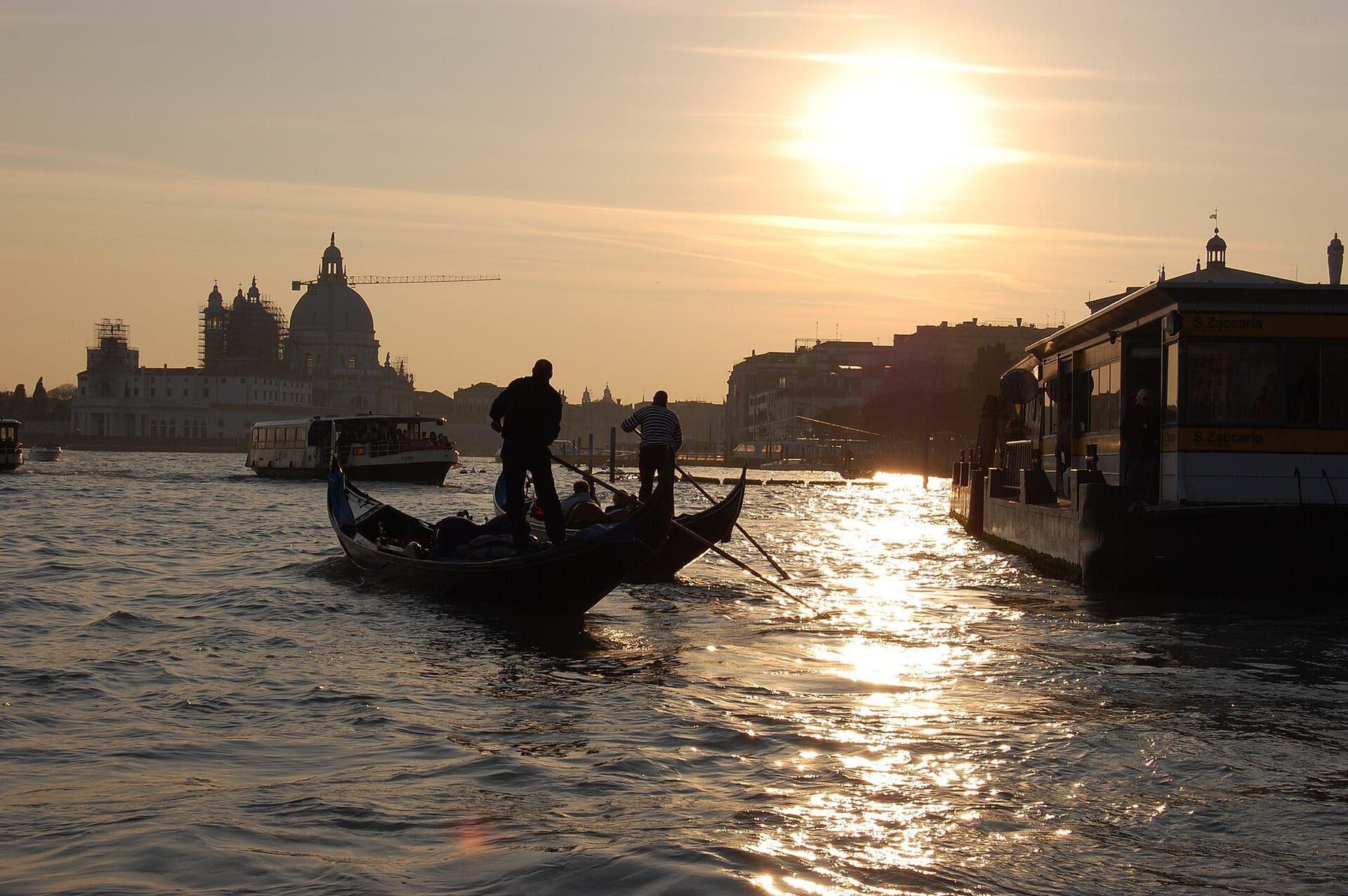
The shared transfer to Marco Polo states four departure points: Piazzale Roma, San Marco, San Zaccaria and Santa Maria Elisabetta on the Lido. The precise jetty and the time are on your voucher — don’t rely on generic directions, because at San Marco there are several jetties within a few dozen metres of one another.
The private taxi works differently: it comes to collect you where you need it. If the hotel has a usable water door, you leave from there; otherwise the meeting point is the nearest accessible jetty. If the pick-up doesn’t take place at a city taxi rank, the tariff provides for the €5 call-out surcharge.
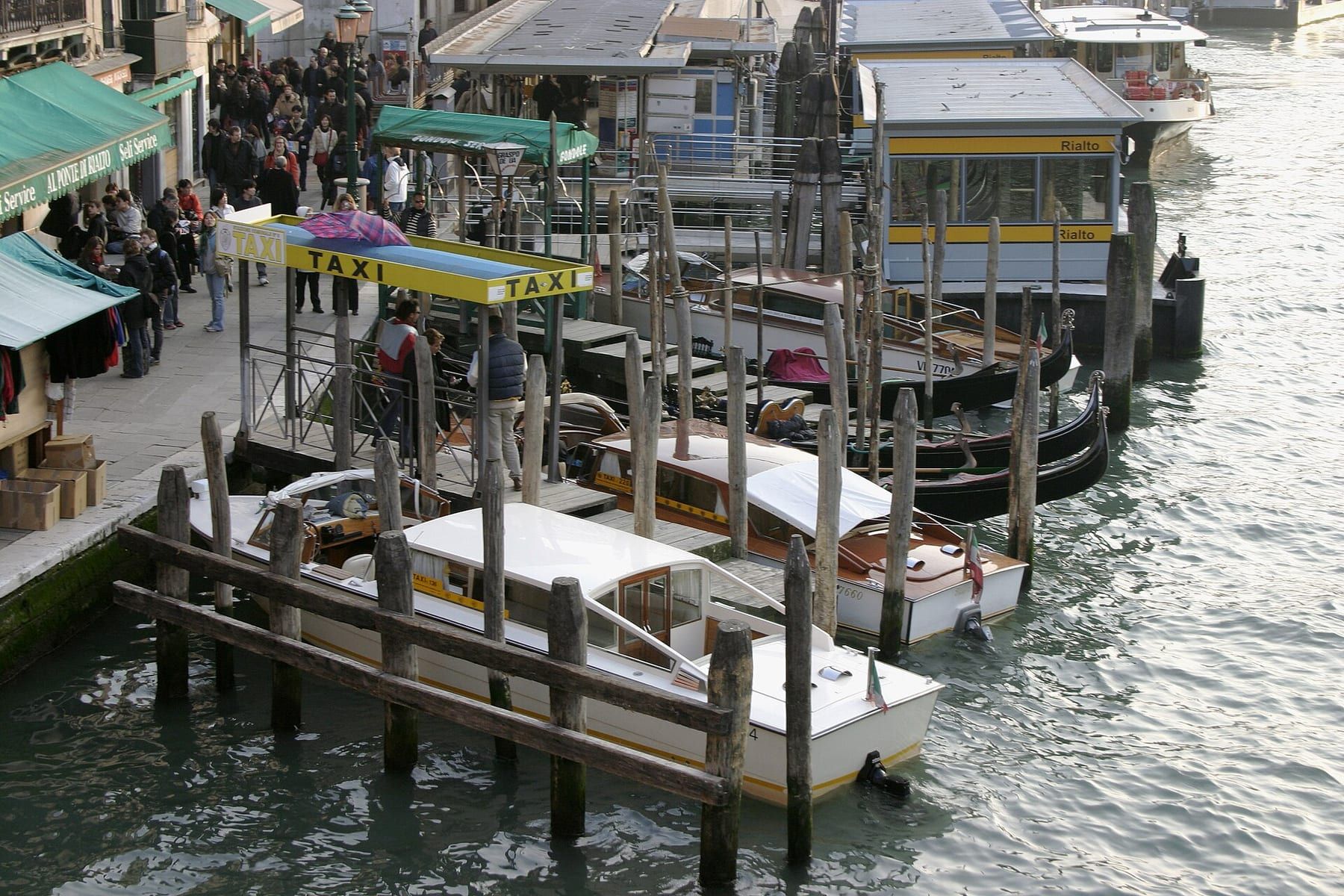
The city taxi ranks in the centre are the places where you’ll find boats waiting without having to call: Tronchetto (two), Piazzale Roma (Parisi rank and Rio Novo), Ferrovia (by the Scalzi church and alongside the ACTV jetty), Rialto (Carbon and Cerva), San Marco (Molo, Ponte della Paglia, Vittorio Emanuele monument, Ca’ di Dio), San Marcuola–Casinò and Lido Santa Maria Elisabetta. Leave from one of these and you skip the call-out surcharge: they’re also the only places where the tariff is posted and can be consulted before you get in.
One recommendation that matters most on the way out: don’t improvise the jetty on the morning itself. The evening before, walk the route from the hotel to the boarding point, calmly and without luggage. It shows you how many bridges lie in between and what they really cost you in time, before it becomes a problem on an empty stomach with the flight closing.
You can also call: the city’s water taxi radio line answers on 199 48 49 50, and the Consorzio Motoscafi call centre on +39 041 522 2303, twenty-four hours a day.
The official tariff, read backwards
The city’s fixed fares are symmetrical: what you pay on the way in, you pay on the way out.
So for the return trip to the airport the figures are €110 from the historic centre, €60 from Murano, €120 from Lido Santa Maria Elisabetta and Excelsior, and €140 from Burano, Torcello, Sant’Erasmo–Treporti–Punta Sabbioni and Fusina. On top come the night surcharge of €10 between 22:00 and 06:00, the €3 per bag beyond the first four and beyond the number of passengers, and €10 per person from the fifth passenger on fixed-fare routes.
The meter — €15 fixed charge plus €2 per minute — applies to journeys within the city, not to the airport transfer. If someone offers you the meter for a run to Marco Polo, you’re about to pay more than the fixed route fare. The complete picture of prices, official and commercial, is at Prices.
Operators, as on the inbound leg, sell the transfer at their own price: the real spread we found is €110–160 per boat, and the platforms add their margin. Some consortia offer a discount on a return booked online: if you’re already booking your arrival at Airport → Venice, close the return in the same go. In high season there’s a practical reason too: the first slot of the morning, for the flights between seven and nine, is the most in-demand of the entire day.
How to save on the way back
- Fill the boat. €110 split six ways is about €18 a head: below four people the private boat rarely pays, above four it beats almost everything.
- Use the shared boat’s outbound advantage. ~40 minutes quoted against 50–100 inbound, at around €39 per person: for two people it’s the best-balanced choice on the return.
- Alilaguna if you have slack. €18 one way, €32 return with the second leg valid for thirty days and revalidated before use. The ticket includes one piece of hand luggage and one suitcase up to 160 cm in total dimensions; extra pieces cost €4 and are bought before boarding.
- The bus if you’re already at Piazzale Roma. About €12 with ATVO or €10 with the ACTV Aerobus, roughly twenty minutes, with no stated luggage limit. If your hotel is right by the railway station, it’s the most rational choice there is.
- Move your departure out of the night window when the flight allows: after 06:00 (after 07:00 on the Consorzio’s price list) the surcharge doesn’t apply.
- Agree everything before you get in: the price, whether it’s per boat or per person, and how you pay. On board cash is often preferred and card acceptance isn’t guaranteed.
When things go wrong: tides, fog, luggage
The tide affects the return more than the arrival, because here the constraint is your own schedule. At high tide the motorboat may not clear the bridges over the inner canals; at low tide the canal in front of the hotel may turn out too shallow. In both cases the meeting point shifts to the nearest usable jetty, normally within a five-minute walk: ask the hotel the day before how the tides are running and where you’re best off waiting.
Lagoon fog, typical of cold mornings, slows the crossing: it isn’t a rare event, and it isn’t a reason to trim your margin. On luggage, finally, shared transfers sold online can limit the number of pieces per person: if you’re going home with more suitcases than you arrived with — and it happens — check the listing or switch to a private boat. The detail on bulky luggage, pushchairs and wheelchairs is at Luggage.
One last scenario: if you have a dawn flight and the idea of moving by boat at five in the morning doesn’t appeal, you can sleep near Piazzale Roma and use the bus or a land taxi — the fixed road fare between the airport and Piazzale Roma is €40, and the figures and rules are at Land taxis · Mestre.
Worth reading alongside your departure
- How the shared seat really works, stop by stop, and what luggage it allows: Shared taxi.
- When having the boat to yourself makes sense, with capacities, per-passenger surcharges and real stowage limits: Private taxi.
- The three ways to book — online, phone, desk at the jetty — and which suits which case: How to book.
In short: from Venice to Marco Polo Airport the water taxi remains the most predictable option, at €110 per boat on the official fare or from around €39 per person shared, with roughly 40 minutes on the water plus 7–10 minutes on foot from the jetty to the terminal. Build your schedule backwards from check-in, add half an hour of margin for tides and fog, and book your seat before the last day: on the return leg, improvising costs you a flight, not ten euros.
Book your transfer to Marco Polo from €39 · ★ 4.2
Frequently asked questions
How early should I leave Venice for Marco Polo?
Work backwards from your airline's check-in closing time and add: 7–10 minutes from the airport jetty to the terminal, around 40 minutes on the water, the time it takes to walk to the boarding point, and a margin for the tides. With a shared transfer, add the time taken by the other stops as well.
Where does the shared water taxi to the airport leave from?
The stated departure points are Piazzale Roma, San Marco, San Zaccaria and Santa Maria Elisabetta on the Lido. The exact jetty and the time are printed on the voucher.
How much does a water taxi from Venice to the airport cost?
The official Comune di Venezia fare for the historic centre ↔ airport route is €110 per boat (€88 for residents and people with disabilities). Operators generally quote €110–160. A seat on the shared transfer starts at around €39 per person.
Will the water taxi pick me up at my hotel?
If the hotel has a usable water door, yes. Otherwise the meeting point is the nearest accessible jetty, normally a few minutes' walk away; with high water or a low tide it can change even at the last minute.
Is the vaporetto or Alilaguna better for getting back to the airport?
Alilaguna costs €18 one way and takes around 60–75 minutes from the St Mark's Basin. The direct bus from Piazzale Roma costs about €12 and takes roughly twenty minutes, but you have to get to Piazzale Roma first.
Is there a surcharge if I leave at dawn?
Yes: the official €10 night surcharge applies until 06:00. Consorzio Motoscafi applies €15 until 07:00 under its own commercial terms. A 05:40 departure costs more than one at 06:10.
Can I book the outbound and return together?
Yes, and it usually pays: you fix the price, and some operators offer a discount on a return booked online.