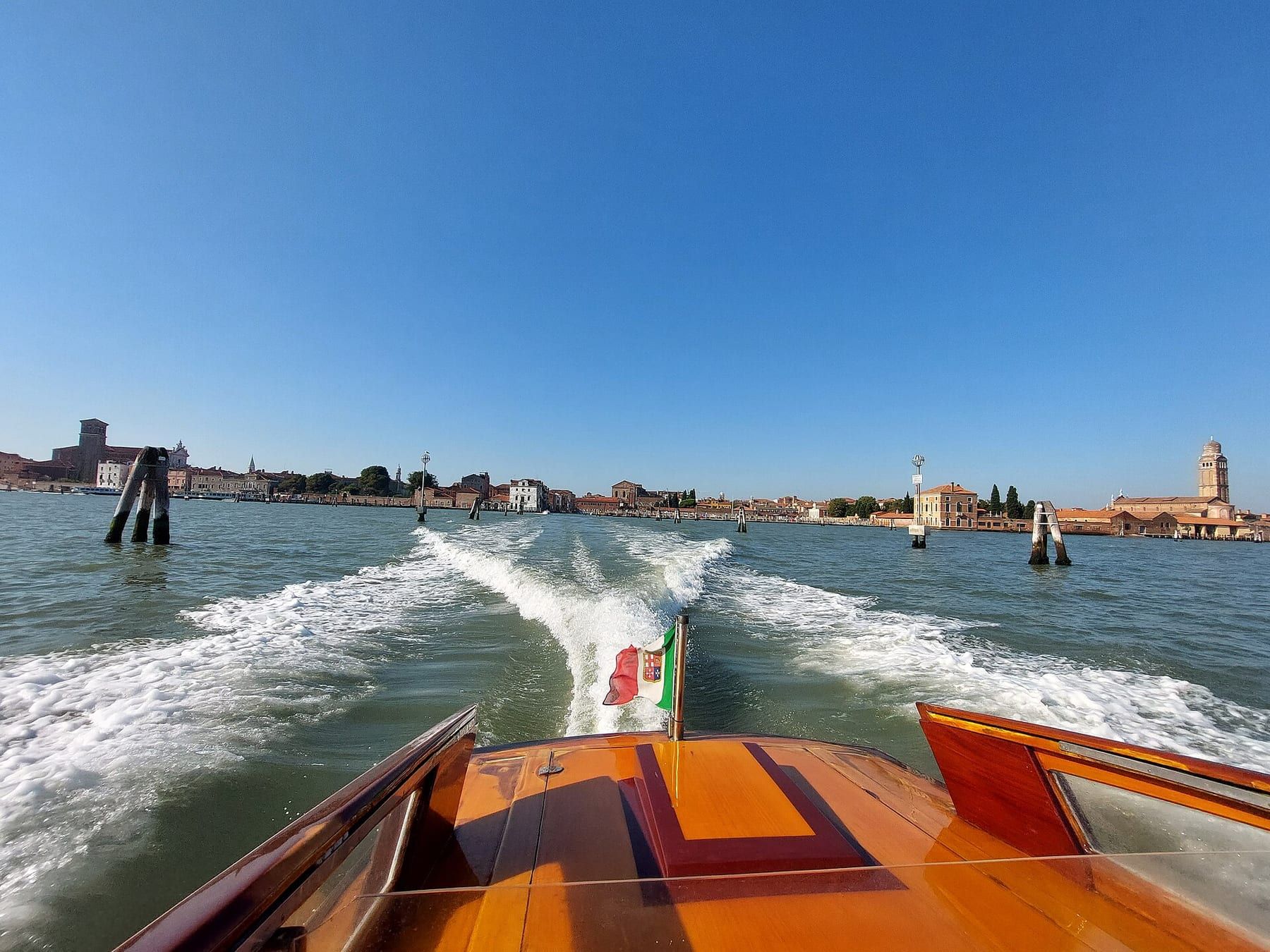
The Venice water taxi is a public non-scheduled transport service: a motorboat with a driver, licensed by the city council, that takes you from any point in the lagoon to any other. In Venetian it’s called a motoscafo, and it’s the only thing in Venice that does the job the white saloon car queuing outside the station does everywhere else. This guide explains who regulates it, what it can legally charge, how to recognise one and what to settle before you get in.
What a water taxi is (and isn’t)
A water taxi is an enclosed hull, usually wooden or fibreglass, with a low cabin, a handful of seats and an open stern deck where the driver loads the bags. It picks passengers up on call or at the taxi ranks, charges fares set by the council, and has no fixed route.
Don’t confuse it with three things that only resemble it from a distance:
- the ACTV vaporetto, scheduled public transport with stops, timetables and a €9.50 ticket valid for 75 minutes;
- the Alilaguna boat, a private scheduled service linking the airport to the city for €18 one way;
- the gondola, which is a sightseeing service with its own route and price, not a way of getting from A to B.
The numbers behind these options are compared on the water taxi, Alilaguna or vaporetto page.
Who regulates the service
Responsibility lies with the Comune di Venezia, Mobility and Transport Directorate — Transport Division. Non-scheduled water transport is governed by the municipal regulation implementing Veneto regional law no. 63/1993, a legal framework quite separate from the one covering land taxis.
Fares, the council states, “are identified and set by the council’s executive board in agreement with the trade associations”. The tariff currently published derives from council resolutions no. 227 and no. 516 and hasn’t been revised in over a decade: it’s the one fixed point in a market where commercial price lists shift every season.
One detail doubles as a practical tool: the tariff must be displayed at every municipal taxi rank, and the council publishes a bilingual version for each one. If you have any doubt about the price, the table is right there, a few metres from the boat.
How many licences exist
The number is capped, and licences are obtained by public competition or by transfer. There are 250 in total:
- 193 “dual” licences — a taxi licence plus authorisation for chauffeured hire, operated with the same boat;
- 7 of those dual licences reserved for the gondoliers’ cooperatives;
- 50 taxi-only licences, of which 25 are on boats fitted with a lift for wheelchair passengers.
Those 25 accessible boats are the most useful item on the list: anyone travelling with a wheelchair needs to ask for one explicitly when booking, because they aren’t the fleet norm. Boats authorised to carry passengers with disabilities may also tie up at pontoons reserved for scheduled services.
How to read the meter
The tariff allows two ways of paying, and it pays to know which one you’re being charged.
On the meter, on city routes: a €15 flat charge on departure plus €2 a minute. The total grows with time spent sailing, not distance, so a short trip through crowded water can cost as much as a longer run across the open lagoon.
On a fixed route, for the journeys listed in the tariff: a single price for that origin-destination pair, whatever the time taken. That’s the formula used for the airport and for connections between the taxi ranks in the centre.
Surcharges are added to both formulas:
| Item | Amount | Note |
|---|---|---|
| Call-out service | +€5 | when boarding doesn’t take place at a taxi rank |
| Night service | +€10 | from 22:00 to 06:00 |
| Each bag beyond the first 4 | +€3 | and beyond the number of passengers |
| Each person from the 5th passenger | +€5 on the meter, +€10 on a fixed route | one bag included |
Residents and passengers with disabilities are entitled to a 20% reduction on every item.
Two warnings. First: the council’s night window ends at 06:00, but the consortia apply their own terms — Consorzio Motoscafi, for example, charges €15 for transfers between 22:00 and 07:00. Second: almost all transfers to and from the airport are sold as a commercial service at an agreed price, dearer than the regulated fare. The complete picture of the numbers is on the fares and prices page, while evening surcharges are explained in water taxis at night.
Where to catch one
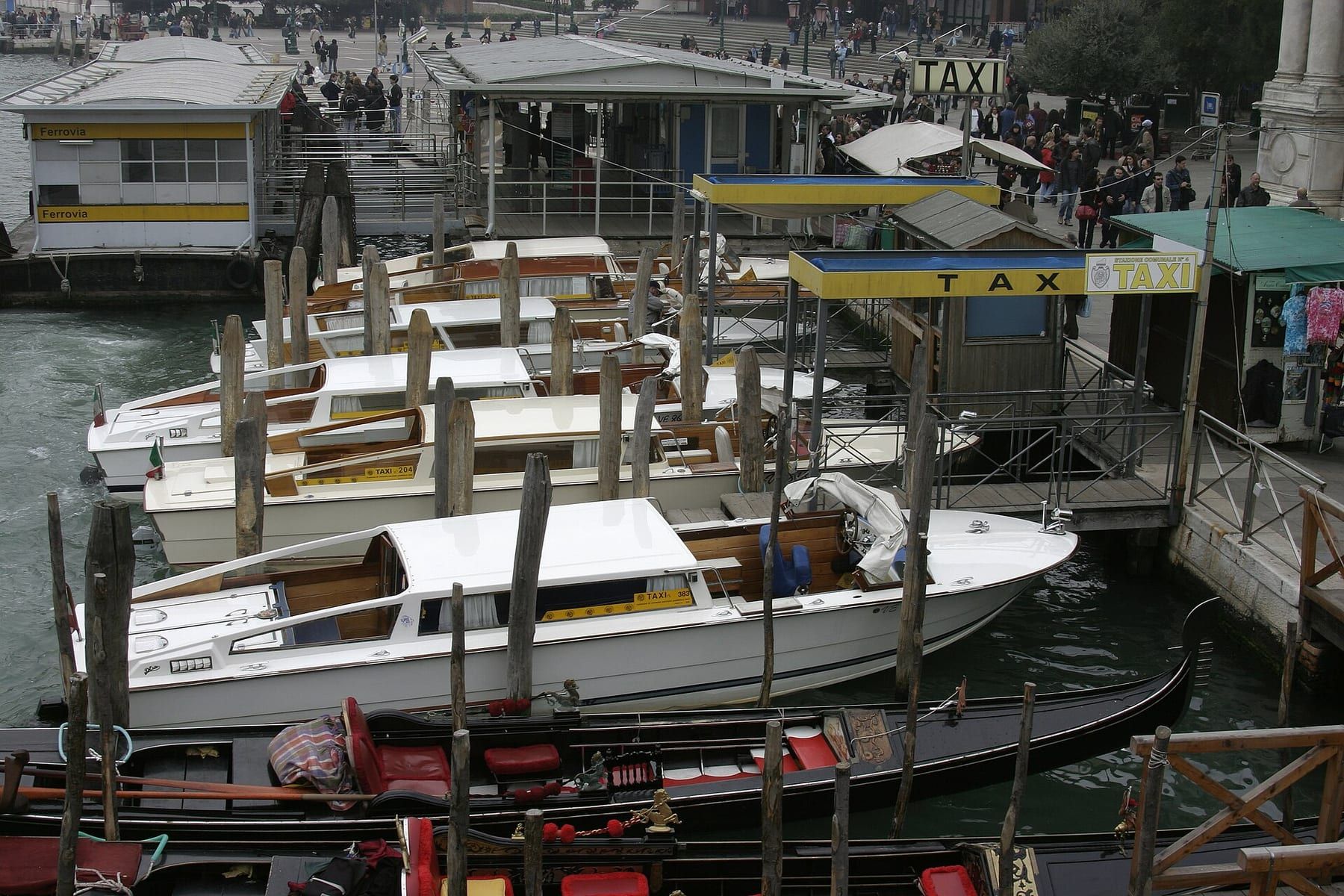
The council runs the municipal taxi ranks, public pontoons where the boats wait for fares. There are fourteen, matching the number of fare sheets the council publishes: Tronchetto (People Mover station and opposite the ACTV pontoon), Piazzale Roma (Parisi ramp and Rio Novo), Ferrovia (by the Scalzi church and beside the ACTV pontoon), Rialto (Carbon and Cerva), San Marco (Molo, Ponte della Paglia, Vittorio Emanuele monument, Ca’ di Dio), San Marcuola Casinò and Lido Santa Maria Elisabetta. The municipal regulation is blunt on one point: waiting for customers is permitted only at these ranks, which are marked by a sign bearing the city’s coat of arms.
Away from the ranks you have two routes: ask at a public or private jetty, or call the council’s water taxi radio line, 199 48 49 50. Either way the call-out surcharge applies. The three ways of booking — online, by phone, at the jetty — are compared in how to book.
How to recognise an authorised boat
The markings on these boats are a municipal rule, not a decorative flourish:
- chauffeured hire boats carry green bands on the side windows showing the authorisation number and the city’s coat of arms, plus a green flag at the bow;
- Gran Turismo boats (larger tonnage and capacity) carry red bands;
- a taxi carries two reflective yellow bands on the outside of the cabin’s side windows and two band-shaped plates, also reflective yellow, showing the licence number, the vessel’s registration and the city’s coat of arms, plus a rigid flag at the bow reading “TAXI” in black on yellow.
The distinction isn’t a formality. A chauffeured hire boat works by advance booking only, sets off from its own mooring and may not wait at taxi pontoons; a taxi can pick you up on the spot and must charge the official tariff. Anyone offering you a ride on the fly from a boat that isn’t a taxi is working outside the rules.
Who the operators are
Licences are held by individual operators, but sales almost always go through consortia. Consorzio Motoscafi Venezia brings together the city’s main operators, states over 100 water taxis, a call centre open 24 hours a day on 041 522 2303 and a GPS system linking every boat to the control room to cut waiting times. Venezia Taxi is the second-largest grouping and states more than thirty years in business; the airport also lists Venice WaterTaxi and Serenissima Taxi among its authorised operators.
Profiles, verdicts and contact details for each are in the operators and platforms section. If you’re arriving by air, the full logistics of the boat dock are in from the airport to Venice.
Capacity, luggage and accessibility
Legal capacity depends on each boat’s certificate rather than a single blanket rule: in practice you travel up to 10 people. Consorzio Motoscafi states a maximum of 10 passengers and up to 12 suitcases, with a €10 surcharge per person from the fifth passenger and €5 per case from the fifth onwards. Individual operators’ terms vary, so declare your number of bags when you book, not at the jetty. Practical advice on oversized cases, pushchairs and wheelchairs is gathered in luggage and accessibility.
Tides, water entrances and meeting points
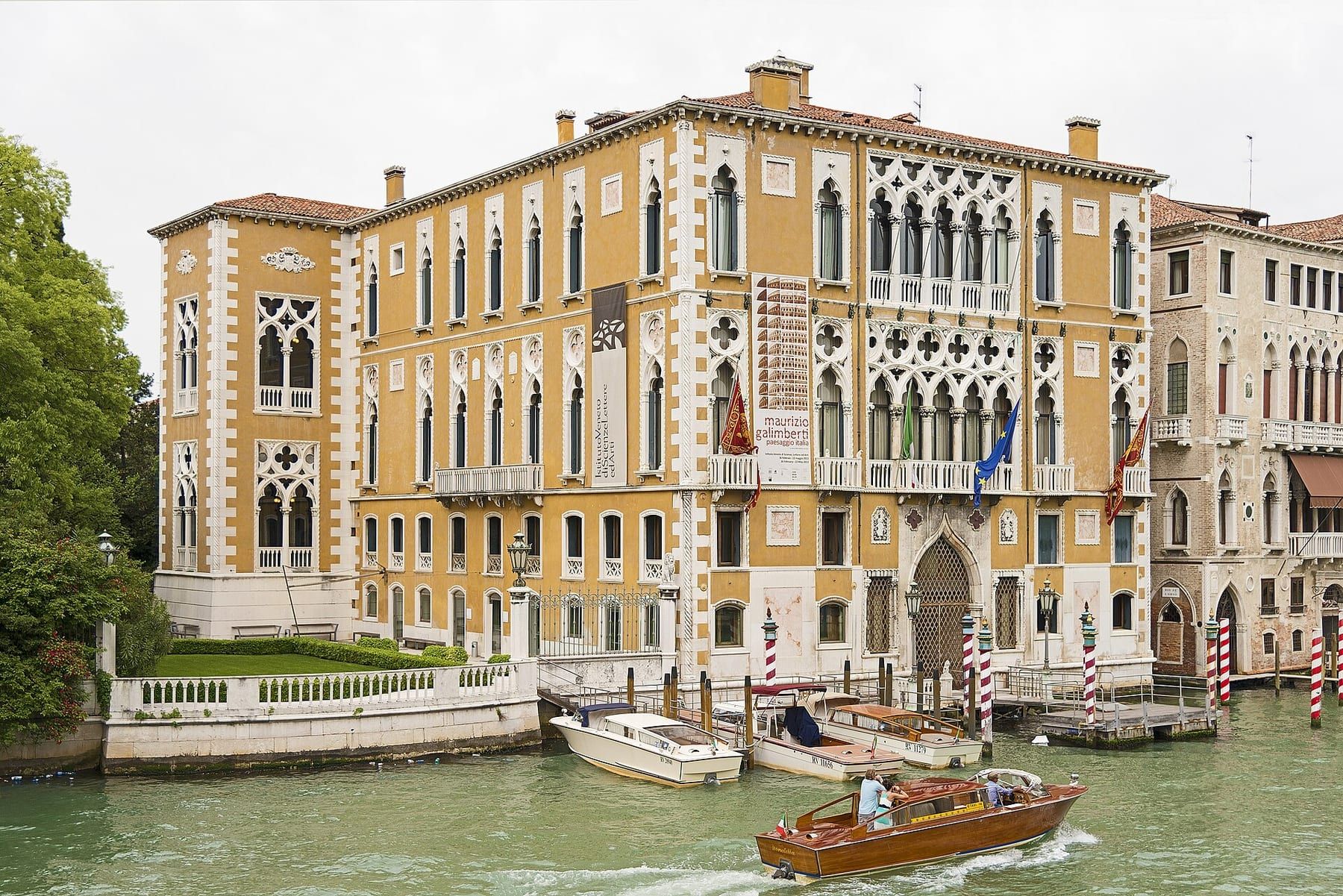
Plenty of hotels have a water entrance, but not all of them can use it all the time. At high water the motorboat may not fit under the bridges on the inner canals; at low tide the canal may be too shallow or the hotel’s step too far from the deck. Either way, standard practice is to disembark at the nearest usable jetty, normally within a five-minute walk, with the driver passing the cases ashore.
Two questions to put to your hotel before you book: does it have a water entrance, and is it usable at any tide? If the answer is vague, budget for the last stretch on foot and at least one bridge.
Payment, tipping and complaints
For online bookings the consortia accept the major cards. On board, card acceptance is not universal: many licence holders prefer cash, so ask before you step aboard. Tipping isn’t expected.
Always agree the price before departure and make clear whether it’s per boat or per person: it’s the same advice the council gives customers of land taxis to head off disputes. If the bill doesn’t add up, your reference is the tariff displayed at the taxi rank: a photo of the table and the boat’s licence number are the practical basis of a complaint. Reports go to the Comune di Venezia through the DIME digital desk or the number 041 041; written complaints go to the Mobility and Transport Directorate, including by certified email.
Etiquette on board
A handful of rules, all of them useful. You get on and off only when the driver says so and is holding the boat steady. Sit down promptly: a motorboat can’t linger at public pontoons. Inside the cabin you stay seated; on the stern deck you stand only at low speed. In the historic centre the boats travel at walking pace to limit their wash, and the meter keeps running: that slow final stretch is part of the price, not a trick to inflate it.
-
from €215 per boat
Book on GetYourGuide -
from €39 per person
Book on GetYourGuide
Understanding how the Venice water taxi works comes down to one thing above all: knowing whether the price you’re quoted is reasonable before you accept it. Always weigh the council fare against the commercial offer, ask whether any surcharges apply, and book ahead when timing is critical. If what you actually need is a land taxi for the mainland, the page on Mestre taxis covers fixed fares and useful numbers.
Frequently asked questions
Who sets water taxi fares in Venice?
The executive board of the Comune di Venezia, the city council, in agreement with the trade associations. The tariff in force comes from council resolutions no. 227 and no. 516 and is displayed at every municipal taxi rank.
How many water taxi licences are there in Venice?
250 in all: 193 dual licences (taxi plus chauffeured hire on the same boat), 7 of them reserved for the gondoliers' cooperatives, and 50 taxi-only licences, 25 of which are on boats fitted with a wheelchair lift.
How does a water taxi meter work?
On city routes with no fixed fare it starts at €15 on departure and adds €2 a minute. If the boat collects you away from a taxi rank another €5 is added, and between 22:00 and 06:00 a further €10.
How do I recognise an authorised water taxi?
A taxi displays its municipal licence number. Chauffeured hire boats carry green bands on the side windows with the authorisation number and the city's coat of arms, plus a green flag at the bow; Gran Turismo boats carry red bands.
Can I pay by card on board?
For online bookings the consortia accept the major cards. On board, acceptance isn't guaranteed: many drivers prefer cash, so it's worth asking before you step aboard.
How many people and how much luggage fit in a water taxi?
Usually up to 10 people, though capacity depends on each boat's certificate. Consorzio Motoscafi states up to 12 suitcases, with a €5 surcharge per case from the fifth onwards.
Who do I report a problem with a water taxi to?
The Comune di Venezia, through the DIME digital desk under Segnalazioni (reports) or the number 041 041; written complaints go to the Mobility and Transport Directorate, including by certified email.
Sources & official data
- Comune di Venezia — Water taxi
- Comune di Venezia — Water taxi fares
- Comune di Venezia — Chauffeured hire transport
- Comune di Venezia — Water transport legislation
- Comune di Venezia — Municipal regulation implementing regional law no. 63/1993 (PDF)
- Consorzio Motoscafi Venezia — Information
- Venice Airport — Transport